
Why Is the Connections Game Different?
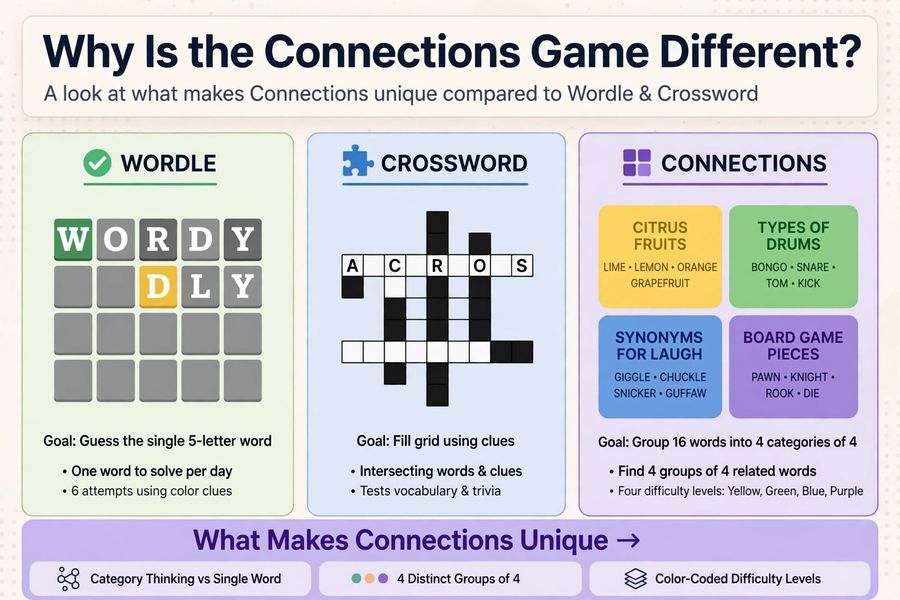
Word games come in many forms, but Connections stands out because it challenges you to find relationships between words rather than simply guess a hidden answer. Instead of searching for the right letters or spelling a secret word, you must figure out how a collection of words fits into four distinct groups.
If you enjoy games like Wordle, Quordle, or other word-guessing puzzles, Connections offers a different kind of challenge. It combines vocabulary, pattern recognition, logical thinking, and a little creativity to make every puzzle feel like a new problem to solve.
What Makes Connections Different From Other Word Games?
The main difference is how you approach the puzzle. In Connections, all 16 words are visible from the beginning, but the categories linking them are hidden. Your task is to identify four groups of four words that share a common theme.
The challenge is that several words may appear to belong together for different reasons. You must find the intended connection, not just a connection that seems reasonable.
For example, a puzzle might contain APPLE, BANANA, ORANGE, and CARROT. Three are commonly recognized as fruits, while CARROT belongs to a different food category. The challenge is to identify the correct relationship rather than group words based on a loose association.
Connections can also use synonyms, familiar expressions, pop culture references, double meanings, and wordplay. This variety makes it difficult to rely on a single strategy.
Also check: What Are Connections Categories? Everything You Need to Know
Connections vs. Wordle: What’s the Difference?
Wordle and Connections are both popular word puzzles, but they test different skills.
In Wordle, you have six attempts to guess a hidden five-letter word. After each guess, colored tiles indicate which letters are correct and whether they occupy the right positions. You use that feedback to narrow down the possibilities.
Connections works differently. You are given 16 words and must sort them into four groups based on shared relationships. Rather than using letter clues to identify one answer, you compare meanings and look for patterns across the entire board.
| Feature | Connections | Wordle |
|---|---|---|
| Main objective | Find four groups of four related words | Guess one hidden five-letter word |
| Core skill | Word association and categorization | Letter deduction and spelling patterns |
| Starting information | All 16 words are visible | The answer is hidden |
| Feedback | Reveals whether a selected group is correct | Shows which letters match and where they belong |
| Challenge | Spotting intended categories among misleading connections | Narrowing down possible answers |
| Mistakes | Usually allowed up to four incorrect submissions | Up to six guesses |
Neither game is automatically harder than the other. Wordle may appeal more to players who enjoy deduction and letter patterns, while Connections is a great fit for those who enjoy discovering relationships between ideas.
Connections vs. Quordle
Quordle takes the basic word-guessing concept further by asking you to solve four hidden five-letter words at the same time. Your guesses provide letter feedback across multiple puzzles, so you must manage several possible answers at once.
Connections does not ask you to discover hidden words. Instead, it tests whether you can recognize the relationships between words already on the screen.
The distinction is simple: Quordle challenges you to solve several word puzzles simultaneously, while Connections challenges you to organize a collection of words into meaningful categories.
Connections vs. Traditional Word-Guessing Games
Traditional word-guessing games often focus on finding a specific word using clues, letter patterns, definitions, or a limited number of attempts.
Connections takes a broader approach. A word’s spelling is not necessarily the important part; its meaning, context, or relationship with other words may matter much more.
For example, a Connections category could contain words that all follow the same word in a familiar phrase. Another might involve words with similar meanings, or words that sound like names of well-known characters.
This means that knowing a word’s definition may not be enough. You also need to think about how it is used and what other words it can connect with.
Four Things That Make Connections Unique
1. You Must Discover Hidden Categories
The game does not tell you what the four categories are before you start. You must work them out by examining the words and testing possible relationships.
2. Words Can Have More Than One Connection
Some words seem to fit several groups. This is one of the most challenging aspects of Connections because an apparently sensible group may not be the intended answer.
3. Wordplay Matters
Connections may rely on puns, homophones, double meanings, expressions, or other language patterns. Thinking beyond the most obvious definition can help you uncover difficult categories.
4. Every Correct Group Changes the Board
Once you identify a group, those words are removed from play. The remaining words become easier to evaluate because you have fewer possibilities to consider.
In the familiar Connections format, the four categories are also associated with difficulty colors: yellow is easiest, followed by green, blue, and purple.
Is Connections Harder Than Wordle?
It depends on your strengths. Wordle can be challenging when there are many possible words that fit the available letter clues. Connections can be difficult when several words appear related or when a category depends on an unfamiliar expression or subtle wordplay.
Players with strong spelling skills may find Wordle more natural, while those who enjoy lateral thinking and recognizing themes may prefer Connections. Both games reward careful reasoning, but they require different approaches.
How Can You Get Better at Connections?
The best way to improve is to practice regularly and pay attention to the relationships you notice.
- Scan all 16 words before making your first guess.
- Look for an obvious category before tackling more difficult connections.
- Consider alternative meanings and familiar expressions.
- Avoid submitting a group just because the words share a broad theme.
- Learn from incorrect guesses and use the remaining words to reconsider possible categories.
You can also practice beyond the daily puzzle. Play Connections in unlimited mode, revisit past games in the archive, or challenge yourself with community-created puzzles.