
What Are Connections Categories? Everything You Need to Know
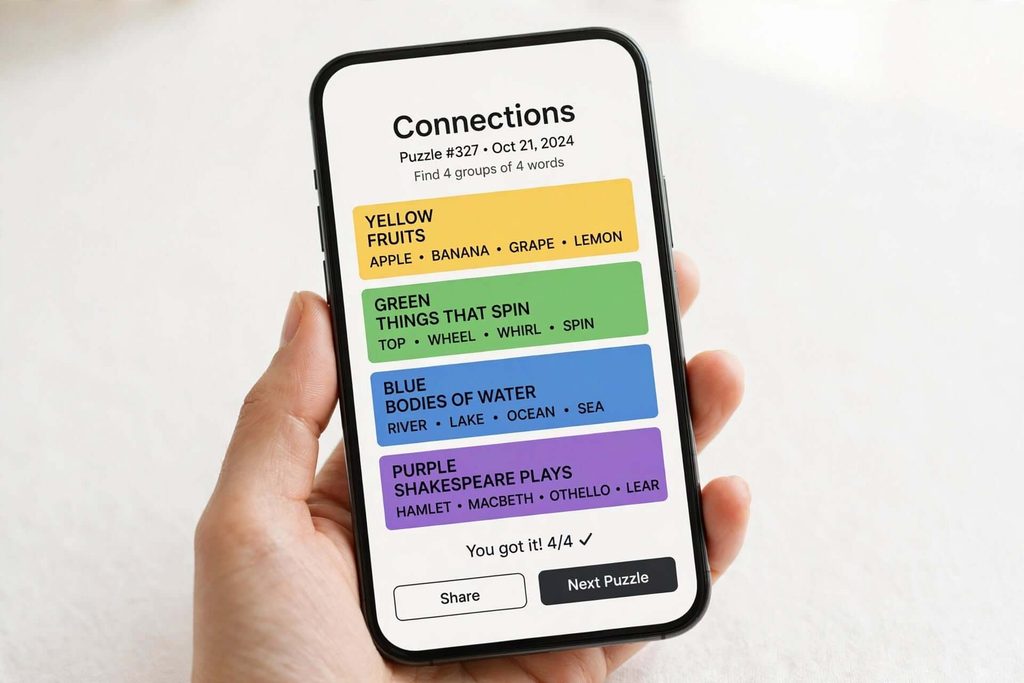
Connections categories are the hidden themes that link groups of words together in the Connections word puzzle. Each group contains four words that share a particular relationship, and your goal is to figure out what those words have in common.
Some categories are easy to spot, such as types of fruit or days of the week. Others are more challenging and may involve synonyms, familiar expressions, word patterns, or unexpected relationships between words.
Understanding how Connections categories work can help you recognize patterns, avoid misleading guesses, and solve puzzles more confidently. Whether you’re new to the game or looking to improve your skills, this guide explains the different types of categories, how difficulty levels work, and strategies for finding hidden connections.
How Do Connections Categories Work?
In the familiar 16-word format, the game presents a grid of words that must be divided into four groups of four. Each group has a hidden category that describes the relationship shared by its words.
Your task is to identify the four words that belong together and submit them as a group. When you find a correct group, its category is revealed. You then continue with the remaining words until you solve the puzzle.
For example, consider these four words:
- APPLE
- BANANA
- ORANGE
- GRAPE
These words share the category Types of Fruit. The connection is straightforward because each word names a fruit.
However, Connections puzzles often include words that could fit several possible categories. APPLE, for instance, could relate to fruit, technology, or words associated with a particular expression. The challenge is to discover the intended connection rather than simply find a connection that seems reasonable.
The Four Connections Difficulty Colors
In most Connections games, each category is assigned one of four colors according to its intended difficulty. The colors are yellow, green, blue, and purple.
Yellow
Easiest category
Yellow groups usually have the most straightforward connections. Look for familiar subjects, everyday items, or words that clearly belong to the same group.
Connection: Days of the week
Green
Moderate difficulty
Green groups may take a little more thought. The words share a recognizable connection, but you might need to consider their meanings or category more carefully.
Connection: String instruments
Blue
Difficult category
Blue groups often rely on more specific knowledge or less obvious relationships. Think carefully about what connects all four words rather than focusing on surface similarities.
Connection: Planets in our solar system
Purple
Hardest category
Purple groups can be the trickiest to identify. They may involve wordplay, hidden patterns, double meanings, or connections that aren’t immediately apparent.
Connection: Wordplay or a hidden relationship
These colors represent the usual difficulty order in the familiar Connections format. Actual difficulty varies by puzzle, and the colors do not indicate a specific type of word connection.
Common Types of Connections Categories
Connections categories can be based on many different relationships. Learning to recognize common patterns gives you more ways to approach a challenging grid.
1. Categories and Sets
These groups contain items that belong to the same recognizable collection. The connection may be based on what the words represent.
Examples include:
- Types of fruit
- Countries in Europe
- Musical instruments
- Board games
- Parts of the human body
When you see several words that represent similar objects or concepts, consider whether they belong to a specific set.
2. Synonyms
Synonym categories contain words with similar or closely related meanings.
For example:
- HAPPY
- JOYFUL
- CHEERFUL
- ELATED
All four words relate to happiness, although their meanings and intensity aren’t exactly identical.
Look for words that express similar emotions, actions, qualities, or ideas. Be careful, though: a word may have several meanings, and only one may fit the intended category.
3. Words That Complete the Same Phrase
Some categories connect words that can appear before or after a shared word to form familiar expressions or compound terms.
For example, consider these words:
- TOOTH
- HAIR
- NAIL
- LIP
Each can precede the word brush to form a familiar term: toothbrush, hairbrush, nail brush, and lip brush.
This type of connection can be difficult because the words themselves may have little in common. Try adding the same word to each item or placing a shared word before them to see whether a recognizable pattern emerges.
4. Wordplay and Hidden Words
Some categories depend on spelling, pronunciation, or the structure of words rather than their meanings.
Possible patterns include:
- Words that contain the name of an animal
- Words that sound like other words
- Words that differ by one letter
- Words that share a particular letter pattern
- Words that can be rearranged to form related terms
For these categories, examine how the words are written and pronounced, not just what they mean.
5. Pop Culture and General Knowledge
Some puzzles draw on familiar people, fictional characters, films, television shows, music, sports, or historical events.
A group might contain four characters from the same series or four performers associated with a particular genre.
These categories can be more challenging if you’re unfamiliar with the subject. When a group doesn’t fit a straightforward word-based pattern, consider whether the connection relies on general knowledge or a shared cultural reference.
6. Words With Multiple Meanings
One of the most challenging features of Connections is that a single word can fit several different themes.
For example, ORANGE could refer to a fruit or a color. BARK could refer to a tree’s outer covering or the sound made by a dog.
These alternative meanings can make an incorrect category appear convincing. Always check whether the proposed connection applies to all four words in a precise and consistent way.
Why Are Connections Categories Sometimes Difficult to Find?
The difficulty often comes from overlapping possibilities. A word may seem to fit one group but actually belong to another, more subtle category.
Imagine seeing four words that appear to be types of food. Three might genuinely belong to that category, while the fourth is included because it completes a phrase with three other words on the board.
Other challenges include unfamiliar vocabulary, obscure references, double meanings, and categories based on spelling rather than meaning.
The key is to avoid committing to the first pattern you notice. Look at the entire grid and compare possible groupings before submitting your answer.
Tips for Identifying Connections Categories
Use these strategies to improve your chances of finding the correct groups.
Read All the Words First
Take a moment to examine the entire grid before selecting anything. Looking at all the words together can reveal patterns you might miss if you focus on only a few items.
Start With the Clearest Connection
If you find a group that you’re confident about, consider solving it first. Removing those words can make the remaining categories easier to identify.
Look for Alternative Meanings
Think about whether a word has another definition, appears in a common expression, or can be interpreted in a different way. A second meaning may reveal the intended category.
Check Every Word in the Group
A good category should explain all four words, not just three of them. If one word feels like a stretch, reconsider the group before submitting it.
Watch for Overlapping Categories
Some words may appear to belong to multiple groups. Ask yourself which combination creates the clearest and most specific connection across all four words.
Save Wordplay for a Second Look
If the obvious categories don’t work, look beyond definitions. Examine spelling, sounds, hidden words, and phrases that the words could complete.
Practise Finding Categories With Connections UK
The more puzzles you try, the more familiar you may become with the different ways words can be connected. Practising gives you opportunities to test your reasoning, recognize patterns, and learn from difficult categories.
Visit Connections UK to play the Daily Connections game or try Unlimited Connections for more puzzles whenever you want another challenge.
Whether you’re looking for a quick daily brain teaser or a longer word-puzzling session, you can put these category-finding strategies into practice and see which connections you discover.
Frequently Asked Questions
How many categories are in a Connections puzzle?
In the familiar 16-word format, there are four categories, each containing four words. Your goal is to identify all four groups.
Do all Connections categories have a specific color?
In the familiar color-coded format, each category has one of four colors: yellow, green, blue, or purple. These colors represent relative difficulty rather than the subject of the category.
Is purple always the hardest Connections category?
Purple is generally considered the most difficult category in the familiar format. It often uses wordplay or less obvious patterns, although the exact type of connection varies between puzzles.
Can a word belong to more than one Connections category?
A word can appear to fit multiple categories because it may have several meanings or share different characteristics with other words. However, each word belongs to only one intended group in a standard puzzle.
How can I get better at spotting Connections categories?
Read the full grid, consider alternative meanings, look for common phrases, and check that every word fits the proposed category. Playing regularly can also help you become more familiar with common word-grouping patterns.
Can I play Connections more than once a day?
Yes! You can play the daily puzzle or enjoy additional rounds using the unlimited games available on Connections UK.
Final Thoughts
Connections categories are the foundation of the game. Each one hides a relationship between four words, ranging from straightforward groups to subtle wordplay and unexpected associations.
Understanding common category patterns can help you approach each puzzle more strategically. Look for clear connections, question your assumptions, and remember that the most convincing answer is the one that explains every word in the group.
Ready to practise? Head over to playconnections.uk and put your word-association skills to the test with daily and unlimited Connections games.