
How to Practice Connections Game
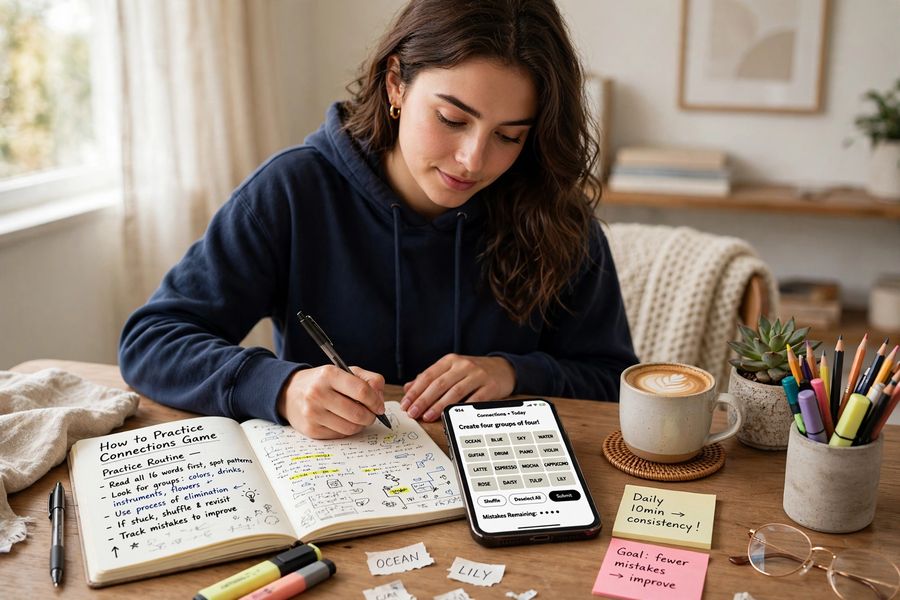
The best way to get better at the Connections game is to play regularly and learn to recognize the relationships between words. Each puzzle challenges you to sort 16 words into four groups of four, with each group sharing a common connection. Some categories are straightforward, while others rely on wordplay, double meanings, or less obvious associations.
Whether you’re new to the game or trying to improve your solving time, consistent practice can help you spot patterns faster, avoid mistakes, and become more confident with tricky categories.
1. Play Connections Every Day
One of the easiest ways to improve is to make Connections part of your daily routine. Each puzzle exposes you to different types of word relationships, helping you build experience with common themes, synonyms, phrases, and other forms of wordplay.
Start with the words you understand best. Look for a group that has a clear connection before tackling the more difficult possibilities.
You can play Connections on our website for free. If you want more practice beyond a single daily puzzle, try unlimited mode to keep solving new games and sharpen your skills.
Play Daily Connections and Practice in Unlimited Mode
2. Replay Past Connections Games
Practicing with previous puzzles is a useful way to learn from earlier challenges. You can revisit games you have already played or explore older puzzles to encounter more examples of how categories are constructed.
As you work through past games, pay attention to the connections you recognized quickly and the ones that caught you off guard. Notice whether a category depends on synonyms, familiar expressions, shared characteristics, or words with multiple meanings.
Our Connections archive page makes it easy to access past games and continue practicing at your own pace.
Explore Past Connections Games in the Archive
3. Try Community Connections Games
Official daily puzzles are not the only way to develop your skills. Custom puzzles created by other players can introduce you to fresh themes, unusual word combinations, and creative ways to connect words.
Community games are especially useful when you want to move beyond familiar categories. Different creators may use topics you have not encountered before, making you think more carefully about how words relate to one another.
Visit our community games page to discover puzzles shared by other players and test your ability to solve their connections.
Play Community Connections Games
4. Look for Multiple Meanings
A common challenge in Connections is that a word can fit into more than one possible group. For example, a word might describe a color, form part of a familiar expression, or have a completely different meaning in another context.
Instead of settling on the first connection you notice, consider whether the words could belong to a more specific category. Ask yourself what makes the four words fit together in exactly the same way.
The more you practice, the easier it becomes to recognize misleading similarities and distinguish a genuine category from a group that only seems to work.
5. Find the Easiest Group First
When you open a puzzle, scan all 16 words before submitting a guess. Look for four words with an obvious shared feature, such as members of the same group, related objects, or words that serve a similar purpose.
Solving an easier category first removes those words from the board, leaving fewer possibilities to consider. This can make the remaining connections easier to spot.
However, be careful with groups that seem obvious. Some puzzles include overlapping relationships designed to encourage incorrect guesses. Make sure you can explain why all four words belong together before selecting them.
6. Learn From Incorrect Guesses
Wrong answers are part of the learning process. When a guess fails, take another look at the words you selected and consider why the group did not work.
You may have overlooked a word with a different meaning, chosen a connection that was too broad, or missed a more precise relationship. Use each mistake as a clue about how the puzzle is structured.
In the familiar Connections format, you have a limited number of incorrect guesses, so avoid submitting a group simply because the words seem loosely related. Take a moment to check whether the connection is specific enough.
7. Practice Different Types of Categories
Connections puzzles can test several kinds of word knowledge. Practicing a variety of puzzles helps you become comfortable with different approaches.
Some common category types include:
- Synonyms: Words with similar meanings.
- Shared themes: Words associated with the same subject, activity, or place.
- Word associations: Items that commonly appear together or belong to a recognizable set.
- Phrase completions: Words that can complete the same expression when paired with another word.
- Multiple meanings: Words connected through a less obvious definition.
- Wordplay: Categories based on spelling, sounds, hidden words, or other language patterns.
If you find one category type especially difficult, pay attention to it during your next practice session. Recognizing your weaker areas gives you a clearer idea of what to work on.
8. Practice Without Rushing
Solving quickly can be satisfying, but speed is not the only measure of improvement. If you rush through every puzzle, you may repeat the same mistakes without understanding why they happen.
Try taking a few extra seconds to inspect the board, compare possible groups, and explain the connection in your own words. Once you become more consistent, you can gradually challenge yourself to solve puzzles faster.
You can also set a personal goal for each session, such as completing a puzzle with fewer mistakes or identifying a difficult category without relying on a hint.
How Often Should You Practice Connections?
For most players, practicing a little each day is a good starting point. A daily puzzle can help you build a habit, while unlimited mode, archived games, and community puzzles provide additional opportunities whenever you want more practice.
You do not need to solve dozens of puzzles in one sitting. Focus on understanding the categories and learning from the connections you miss. Regular, thoughtful practice is more useful than repeatedly guessing without a strategy.
Frequently Asked Questions
How can I get better at Connections?
Play regularly, look for clear groups first, consider multiple meanings, and learn from incorrect guesses. Practicing different puzzle styles can also help you recognize a wider range of connections.
Can I practice Connections after finishing the daily puzzle?
Yes. You can use unlimited mode to keep playing, visit the Connections archive to solve past games, or explore community games created by other players.
Are past Connections games useful for practice?
Yes. Past puzzles let you encounter different category styles and review connections you may have missed. They are a helpful way to develop your pattern-recognition skills.
Are community Connections games good for beginners?
They can be. Community puzzles offer a variety of themes and difficulty levels, so you can explore different word relationships and gradually challenge yourself with less familiar categories.
Start Practicing Connections Today
The more you play, the more familiar you become with the patterns and word relationships that make Connections challenging. Practice with daily puzzles, revisit older games, and explore the creative categories in community puzzles to keep building your skills.
Ready for another round? Play Connections in unlimited mode, solve a past game, or discover community puzzles and put your word-association skills to the test.